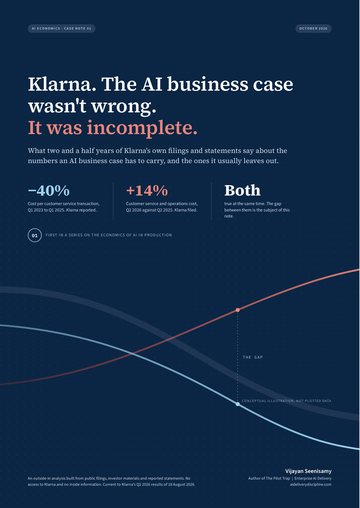
Case notes on the economics of AI in production, built from what companies filed and said, with the gaps marked. Each note separates the record from the reading, and ends with a tool you can use on your own program.
Case Note 02 follows in December 2026. Notes are numbered and permanent, and each one has its own newsletter issue.
An outside-in analysis of one company’s AI economics, built from its own filings, investor materials and public statements. No access to the company, no inside information, and no estimates of figures it has not disclosed. Where the record stops, the note says so.
The company is the evidence, not the target. Every note tests an assumption that enterprises are making right now, and the company is the clearest public example of what happens when that assumption meets production. The point is the number the reader should ask for next, in their own steering meeting.
Most retellings of these cases come from one interview and one article. The notes go to the filing. Companies tell regulators things they do not tell journalists, and the version a board should repeat is the one the company is accountable for.
The notes are the evidence. These two papers and one section of the Standard are the argument they test.
Why enterprise AI programs become unprofitable in year two. Names the cost that compounds invisibly, the month it turns negative, and the discipline that catches it.
For a century, output, people and cost moved together. Agents break that chain, and the number every budget is built on stops measuring what everyone assumes it measures.
Section 6 of The Agent Estate Standard: cost per successful outcome, the review triggers that carry a value, and the criteria that retire an agent.
The AI Delivery Discipline newsletter, plus The First 90 Days of an AI Delivery Manager as a welcome guide.